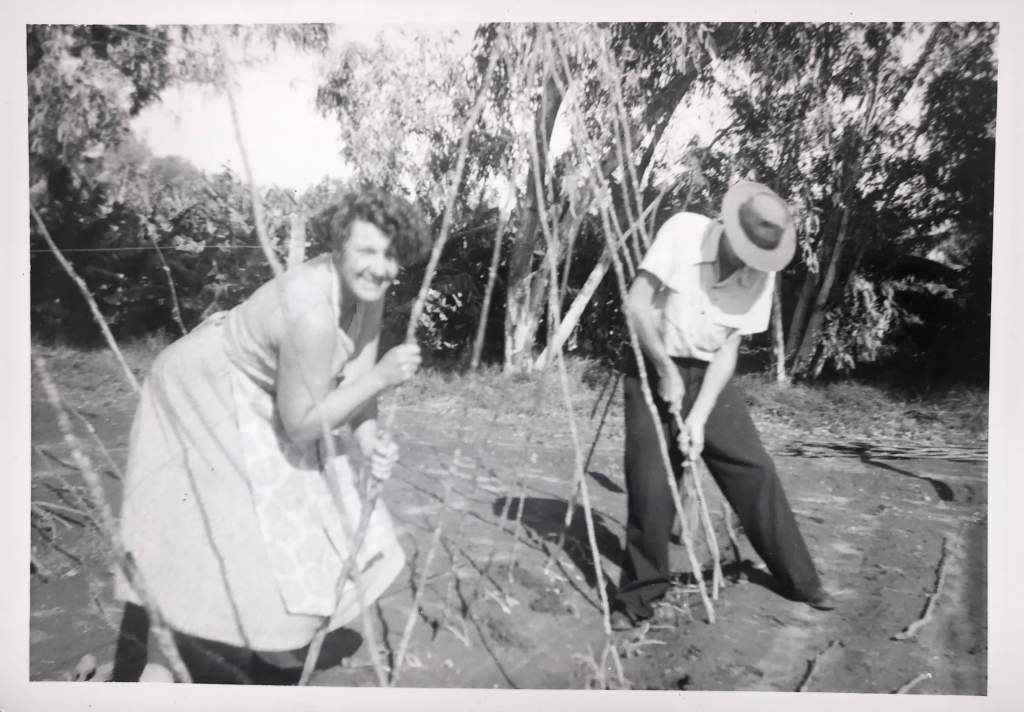
staking beans c1943.
After working in Carnarvon for three years, Stan had enough money saved and had established himself well enough to return to Perth and marry Marjory Hollings. They were married at the Wesley Chapel in the centre of Perth in 1938. Marjory returned to Carnarvon with Stan to start married life on Riverside Plantation on South River Road. As share farmers they grew beans and other vegetables.
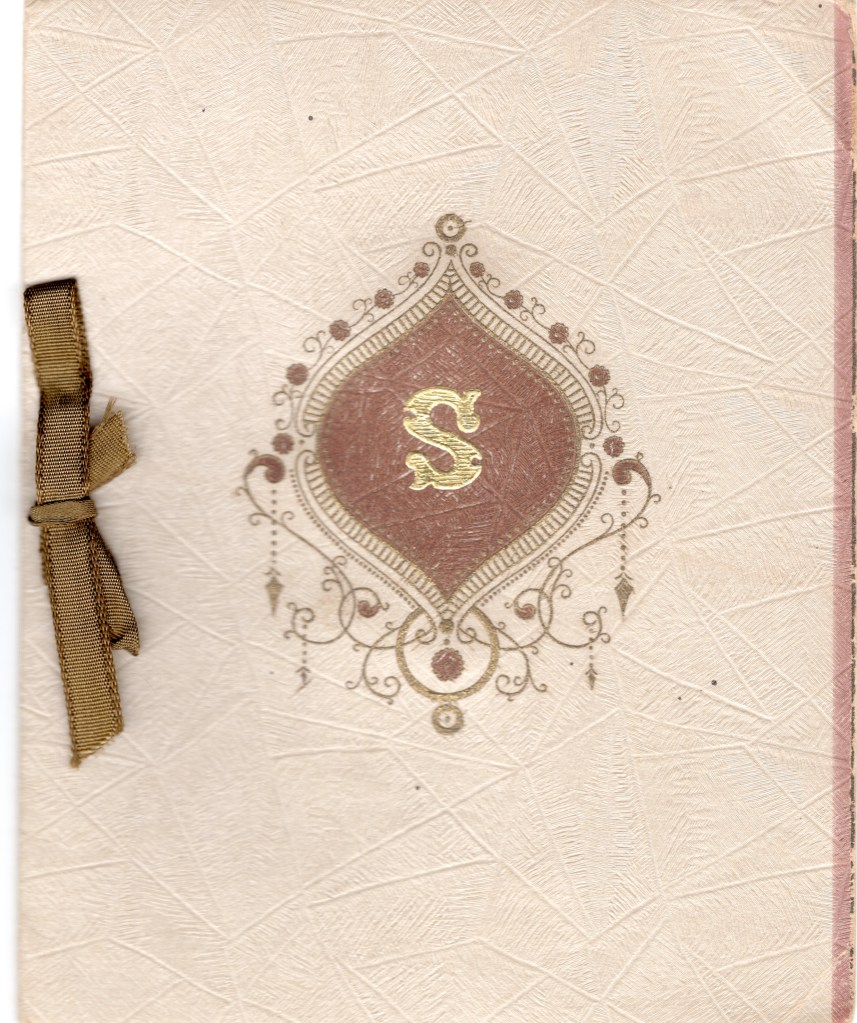
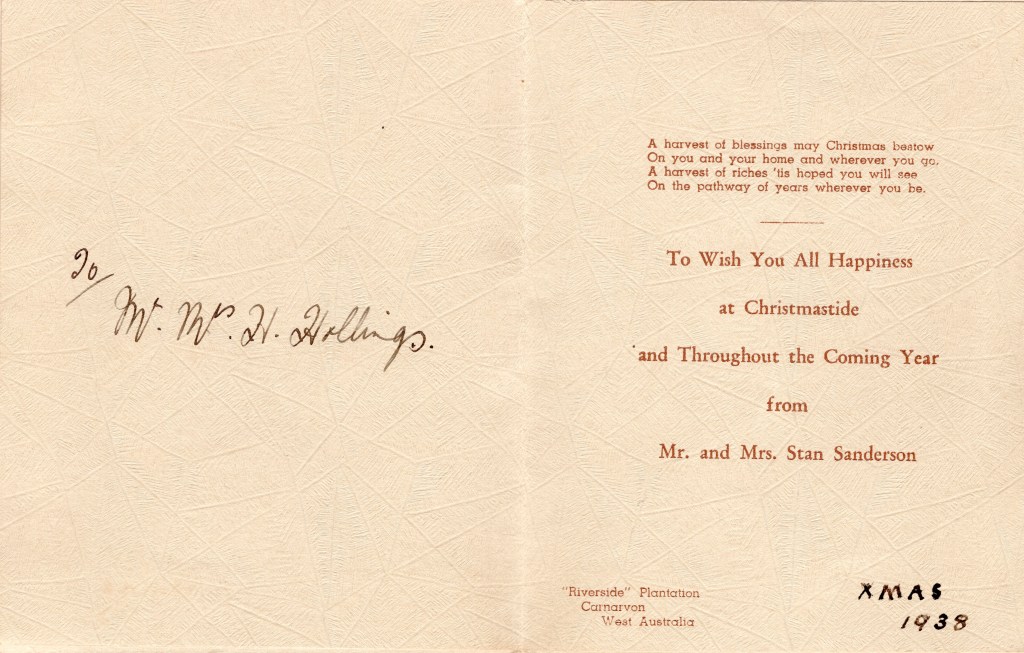
For their first Christmas in Carnarvon, Marjory sent personalised cards to her parents and friends in Perth. The beautiful, embossed cards included an elaborate letter S and addressed from Riverside Plantation, Carnarvon. The verse in the card reflected the new life they were embarking on…
A harvest of blessings may Christmas bestow, On you and your home and wherever you go. A harvest of riches ’tis hoped you will see, On the pathway of years wherever you be.
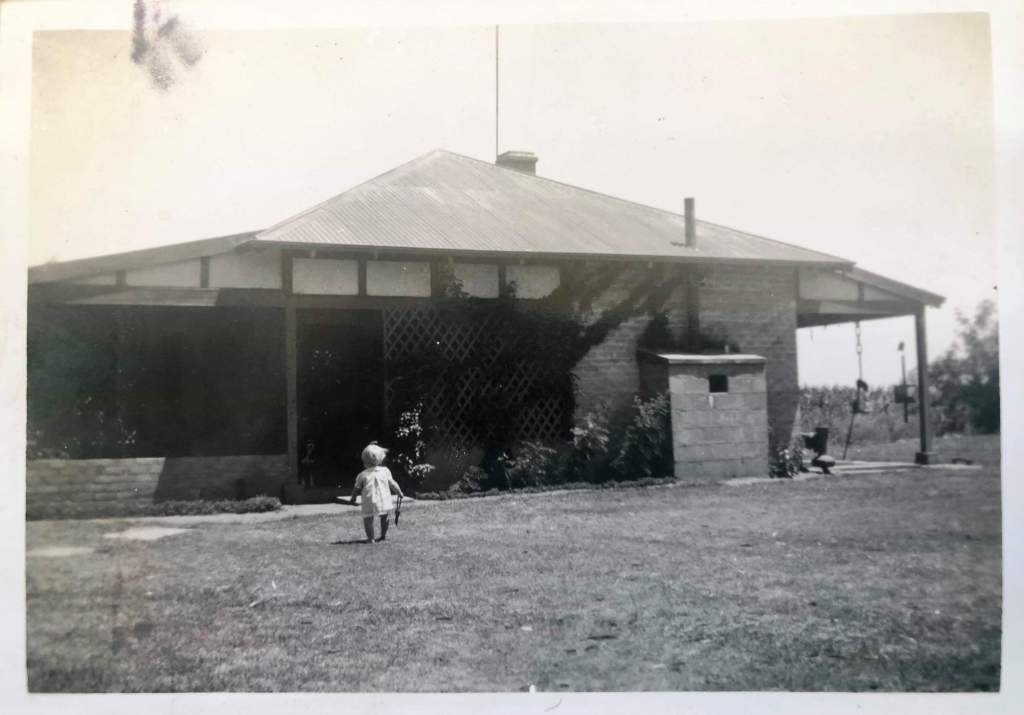
In June 1939 Stan and Marjory welcomed a daughter and named her June; in honour of the month she was born. At this time Stan was working mainly for Fergusson-Stewart while continuing to live on South River Road. A photo of June playing in front of the house on Inverstewart plantation suggests that Stan and Marjory may have lived on the plantation prior to Stan buying the property in 1942.
From 1942 the property was known as Inverstan Plantation and the house became the family home for the next sixty years.
In February 1943 Laurie was born and then another baby, Alan, arrived on Mothering Sunday in May 1944. It was another four years when Gordon was born in May 1948, completing Stan and Marjory’s family.

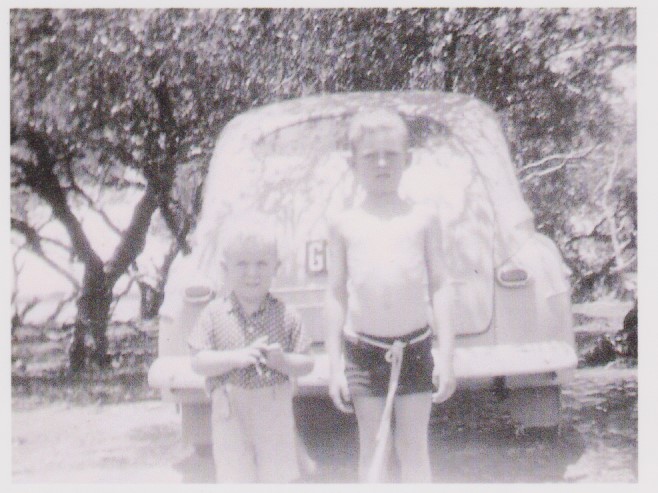
Growing up on the plantation was a mix of carefree adventure and work. For the boys this included preparing the ground for new crops, harvesting, grading and packing. It was hard labouring work. During this period they continued to clear and level the land on the river side of the property. The purchase of a Massey Ferguson tractor significantly changed the way they worked. Levelling and preparing new plots and the harvesting of bananas became a little less labour intensive. The tractor continued to be a key piece of machinery for many years.

Marjory and June did their fair share of work in the packing shed. They also provided a consistent daily schedule with morning tea at 10 o’clock, lunch at noon and afternoon tea at 3 o’clock. Freshly baked cakes, usually orange or lemon, or chocolate (when the citrus was out of season) were served and cold meats and salad for lunch. Marjory and June also kept busy with keeping the house and garden, washing and mending clothes.
Sunday was kept for the Lord and if not attending church in town, Marjory would play hymns on her piano. Her joyful singing heard beyond the walls of their home, lifted on the breeze that rustled through the river gums. Often Stan and Marjory would host members of the Uniting Church with an open air Sunday congregation in the beautiful garden surrounding the main house.
Stan and Marjory were committed to the children receiving a sound education. They all attended boarding school in Perth with June attending Methodist Ladies College and the three boys all took their turn at Wesley College.
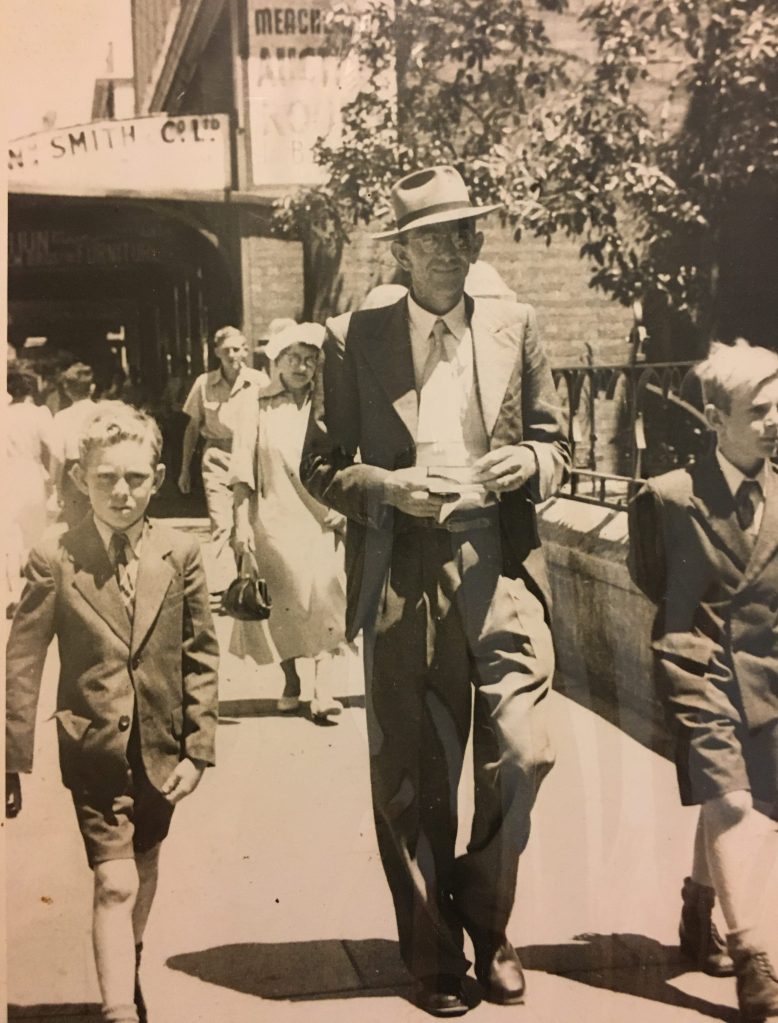
When home from boarding school, the Elephant House was a place for Laurie and Alan to hang out. They made a ladder from the giant bamboo stands that grew wild on the banks of river. This was found leaning up against the outside wall providing access to the loft door. Mates from nearby plantations would come over to muck around. If not down the river they would be found skylarking somewhere on the expansive property.
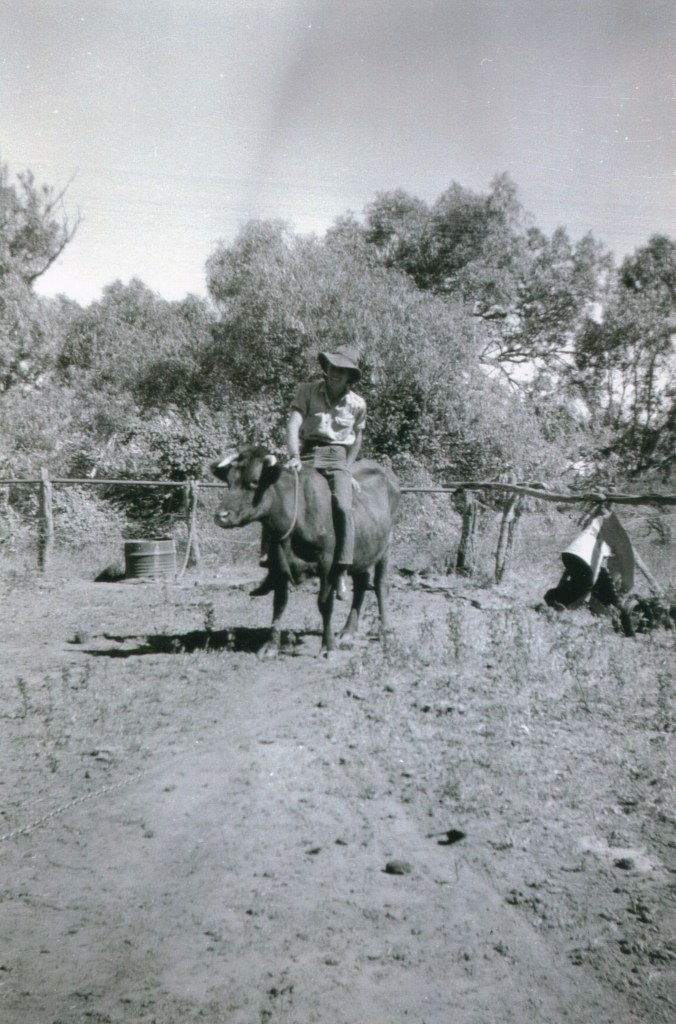
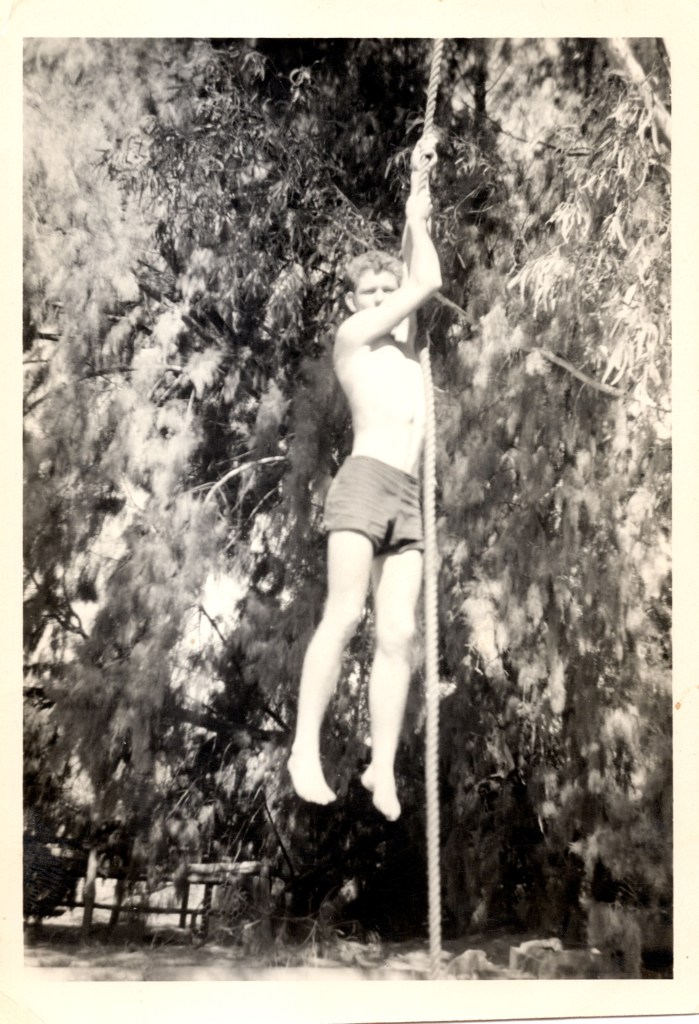
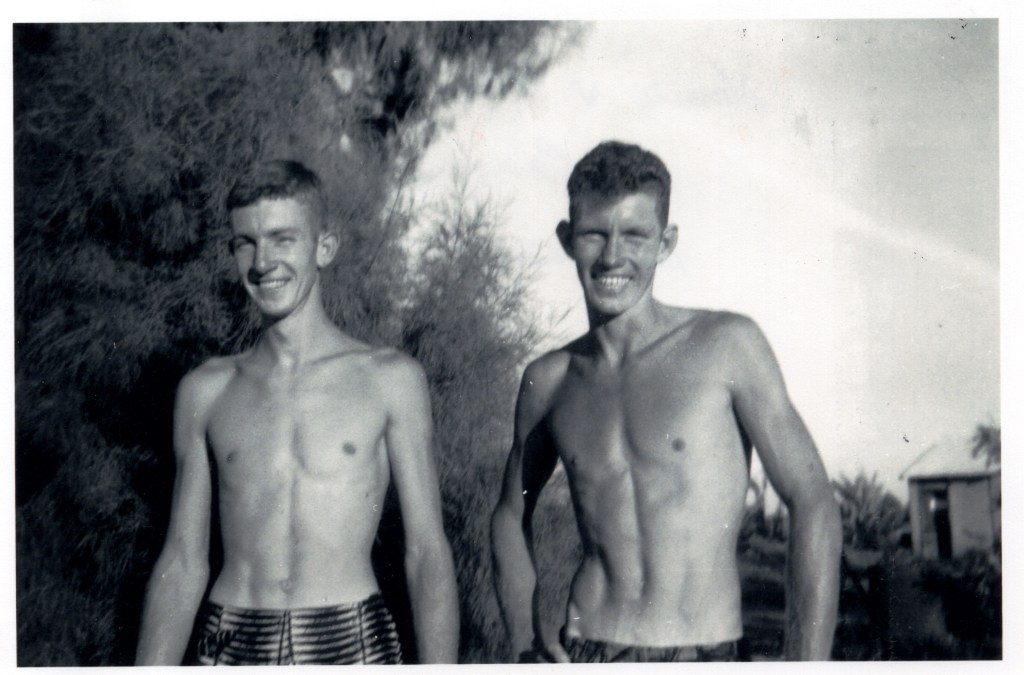
Having completed their schooling, the first to marry was June who had met her beau Bill Lyall while working in town at the Commonwealth Bank. They married on 3 February 1962 and moved into a house located on the north side of the plantation.
They lived on Inverstan Plantation for about four years. Bill, while still working at the bank also tended his own patch of bananas. June had her first two children, Stephen and Peter while living on Inverstan Plantation. They later moved to Bill’s parents plantation, known as Lyall Plantation, about two kilometres down the road. In 1968 their daughter Wendy was born.
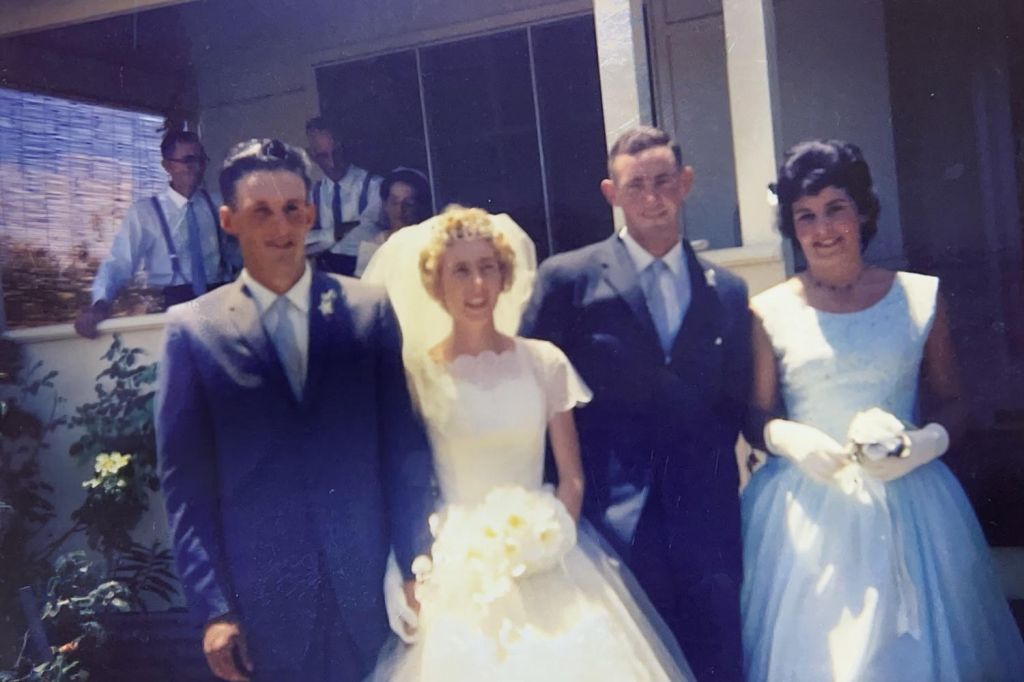
The year of 1964 was a busy time in the Sanderson family with two weddings. Laurie married Joy Williams on 28 March. This celebration was soon followed with the wedding of Alan to Joan Freeman on 30 May.

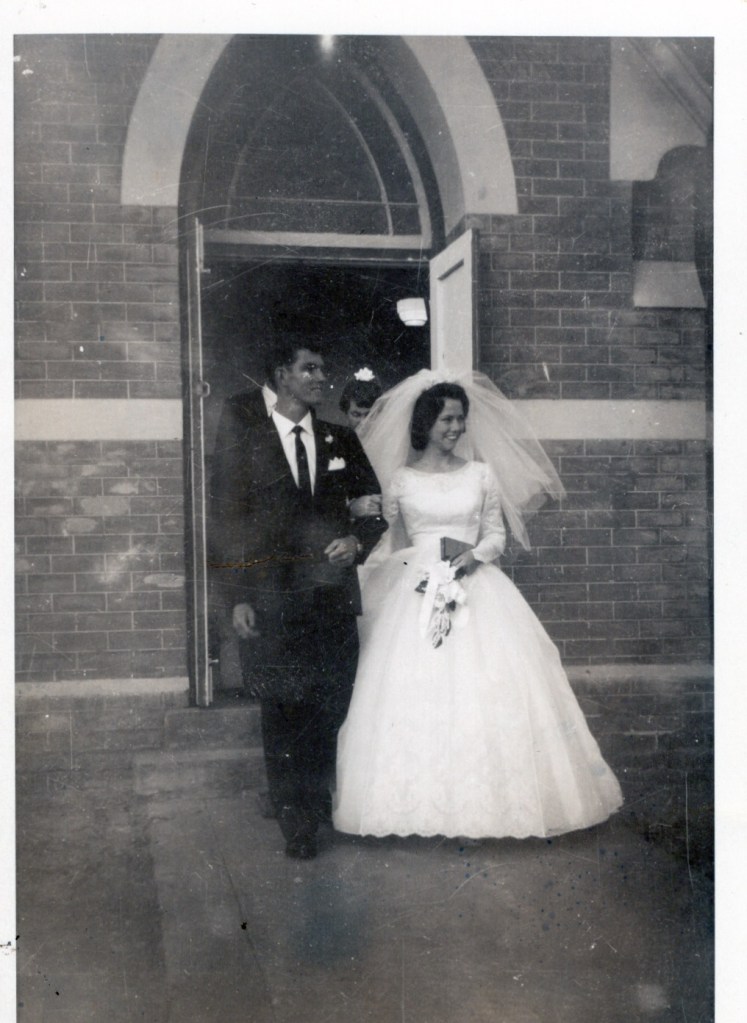
While Laurie and Joy were planning and building their family home on the east corner of the property they set up home in the Elephant House. In September 1964 Suzanne was born. When Joy returned from Carnarvon Hospital, Suzanne’s first home was the Elephant House. Nearby and closer to the river the construction of their home continued.
A double bed, a wardrobe, small kitchenette, table, two chairs and a bassinet were all the furniture that could fit in their small single room temporary home. Joy remembers how she would place Sue in the pram and sit under the shade of a large silky oak tree to catch the breeze on a hot day.
Construction of their new home was finished in time for the arrival of their second baby. Wayne was born September 1965 and they moved into their new home where they lived for the next forty years.
Alan and Joan also made the Elephant House their home and expanded the living space by adding a room to the side, effectively doubling the size. They also had a small kitchenette, table and two chairs in the small front room. Joan recalls sitting in the packing shed with Alan stringing together small cuttings of bamboo to make a bamboo curtain. This hung across the doorway to the additional room, effectively dividing the sitting area from the bedroom. Outside the front door a nice strip of green lawn and flowering vincas made the Elephant House a home the young married couple.
Alan and Joan welcomed the arrival of their first baby Vicki in February 1966. Later they lived in the house on the north side of the property, where Bill and June had lived, and Tami was born in May 1970.
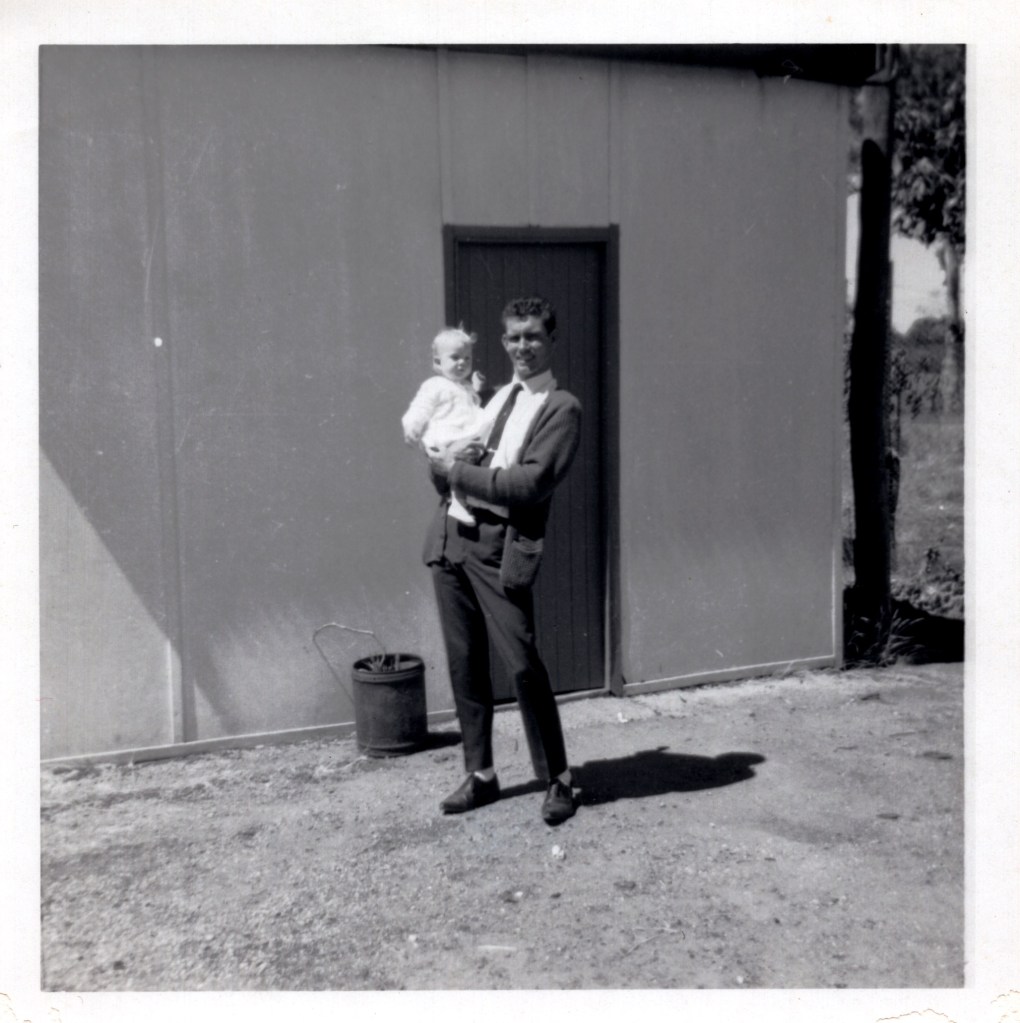
While the Elephant House provided the first home for newly weds and babies, it also provided temporary lodgings for young people who needed somewhere to stay.
Graeme Eastwood, known locally as Drifty, was a young sign writer who ended up in Carnarvon looking for work. Laurie recalls Drifty living in the Elephant House for a while as a lodger. Drifty became friends with many, including the DeBoni family who lived on a plantation on the other south side of the river. He later married Jana DeBoni and established a successful signwriting business in town.
A shearer was another lodger who spent a few nights in the Elephant House. His stay resulted in the unfortunate loss of a treasured watch. One night when he retired to the wire framed bed in the loft he placed his watch on a ledge of the internal wall. To his dismay his prize possession fell between the bricks and internal wall. All efforts to retrieve it failed and the watch remains lost in the walls of the Elephant House to this day.
It was Laurie and Alan who continued living and working on the plantation with their father Stan. June married Bill and they lived on the Lyall’s Plantation a couple of kilometres down the road. Gordon completed a mechanical apprenticeship with Main Roads and worked for the public authority for many years. Gordon married Rae Thomas and they lived in town. Gordon and Rae had two boys, Troy in June 1975 and Clint in February 1978.
The Elephant House played a part in the lives of the first generation of the Sanderson family. The story continues next time with the grand children who found a different purpose for the Elephant House.
 The Elephant House